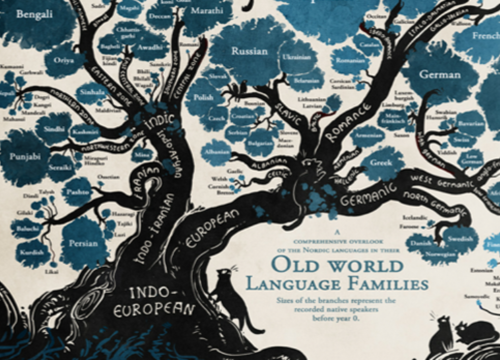
To truly understand the rich history of the Western Balkans, one must first look at the Albanian language origins. The history of this language stands as one of the most captivating and heavily debated mysteries in European historical linguistics. Known natively as shqip or gjuha shqipe, Albanian occupies an entirely independent branch within the expansive Indo-European language family.
Unlike the Romance languages that clearly trace their lineage back to Latin, or the Slavic tongues that share deeply interconnected roots, Albanian has no living sister languages. It sits completely alone on its own linguistic branch, making it a rare and resilient survivor of the ancient Paleo-Balkan languages.
The Deep Mystery Behind Albanian Language Origins
The exact ancestors of the Albanian language have sparked intense academic debate for centuries, primarily divided between the Illyrian and Thracian hypotheses. The Illyrian thesis posits that modern Albanian descends directly from the ancient Illyrian tribes who inhabited the western Balkans for millennia prior to the Roman conquest.
DNA and Ancient Illyrian History
Recent advancements in genomic mapping have provided unprecedented, undeniable clarity to this debate. A comprehensive 2023 genetic study published in the prestigious journal Science revealed robust signals of genetic continuity. The data confirms that modern Albanians share significant paternal ancestry and demographic continuity with West Balkan Late Bronze and Iron Age populations. This explicitly includes those classified by classical authors as Illyrians, proving an unbroken genetic chain that persisted well into the Early Medieval period.
The Epic Struggle for the Albanian Alphabet
Despite its ancient roots, the language’s first documented appearance in the historical record occurred surprisingly late. Because of this exceptionally late attestation, the precise evolutionary steps of the language were long shrouded in mystery.
- 1462: The earliest confirmed document in Albanian is a baptismal formula written in Latin characters by Pal Engjëlli, the Archbishop of Durrës.
- 1555: The first substantial text, the Missal of Gjon Buzuku, was published to help Catholic priests conduct mass in the native tongue.
Historically, the alphabet used by Albanians depended heavily on religious and imperial affiliation, leading to a chaotic mix of scripts:
- The North: Catholic Albanians primarily utilized Latin letters.
- The South: Orthodox Albanians adopted Greek scripts.
- During the Ottoman Era: Muslim populations utilized Arabic and Ottoman-Turkish characters.
In the 18th century, an incredible phenomenon occurred in central Albania with the creation of original, indigenous alphabets—most notably the Elbasan script invented by Dhaskal Todhri. However, the ultimate unification of the written language occurred at the Congress of Manastir in 1908. Here, Albanian intellectuals from all religious backgrounds gathered to standardize the modern Albanian alphabet we use today, choosing a purely Latin-based script composed of 36 letters, perfectly tailored to the unique sounds of the shqip tongue.
The Great Divide: Gheg vs. Tosk Dialects
While the language is unified in its written form today, the spoken word exhibits a complex and beautiful array of internal dialect divisions. The country is primarily split geographically by the Shkumbin River, creating two distinct linguistic worlds:
- Gheg (The Northern Dialect): Spoken north of the Shkumbin River, encompassing northern Albania, Kosovo, and parts of Montenegro and North Macedonia. Gheg is famous for its nasal vowels and the preservation of the ancient infinitive verb form. It is the language of the rugged Albanian Alps and the epic highland lute songs.
- Tosk (The Southern Dialect): Spoken south of the Shkumbin River. Tosk is characterized by “rhotacism” (where the ancient ‘n’ sound shifted to an ‘r’ over time) and the absence of nasal vowels. During the communist era, the Tosk dialect was heavily favored and ultimately formed the basis for Standard Modern Albanian.

The Diaspora Dialects: Arbëreshë and Arvanitika
Perhaps the most incredible proof of the language’s resilience lies outside of Albania’s modern borders. Following the death of the national hero Skanderbeg in the 15th century, many Albanians fled the Ottoman invasion to southern Italy and Greece. Today, their descendants still speak Arbëreshë (in Italy) and Arvanitika (in Greece). These diaspora dialects act as linguistic time capsules, preserving medieval Albanian vocabulary that has long been lost in the modern motherland!
A Unique Indo-European Isolate
The absolute resilience of the language is defined by its remarkable capacity to survive. Over thousands of years, the Albanian people absorbed foreign lexical influences from Hellenistic, Roman, Byzantine, and Ottoman dominations. Yet, through all of these empires, they never lost their foundational, indigenous grammatical scaffolding.
For those interested in the cultural fabric of the nation, understanding the Albanian language origins provides unparalleled context. You can learn more about how this cultural resilience translates into real-world local hospitality by reading about the Besa Albanian code of honor. For a deeper academic dive into its roots, explore its classification on Wikipedia’s Albanian Language profile.